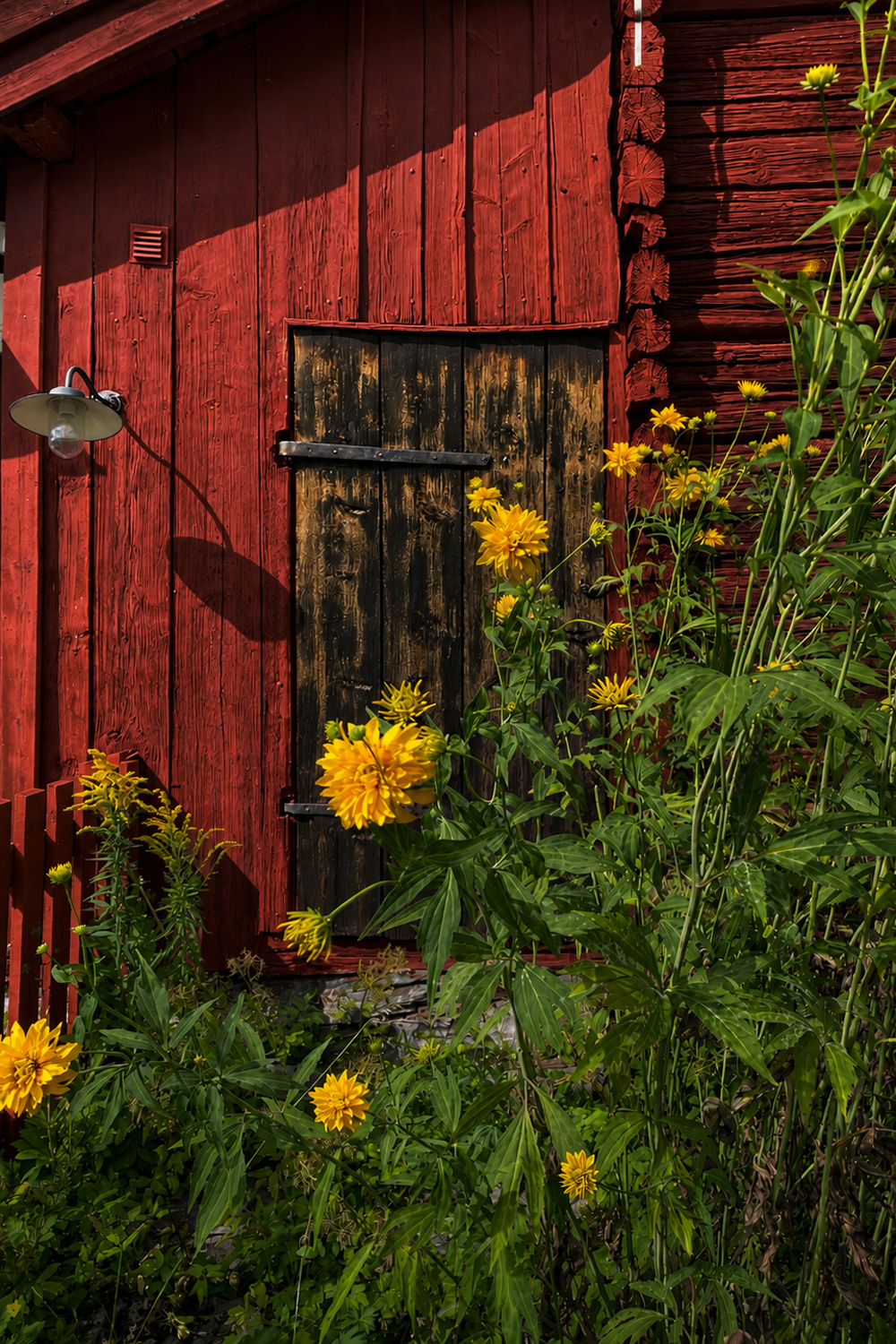
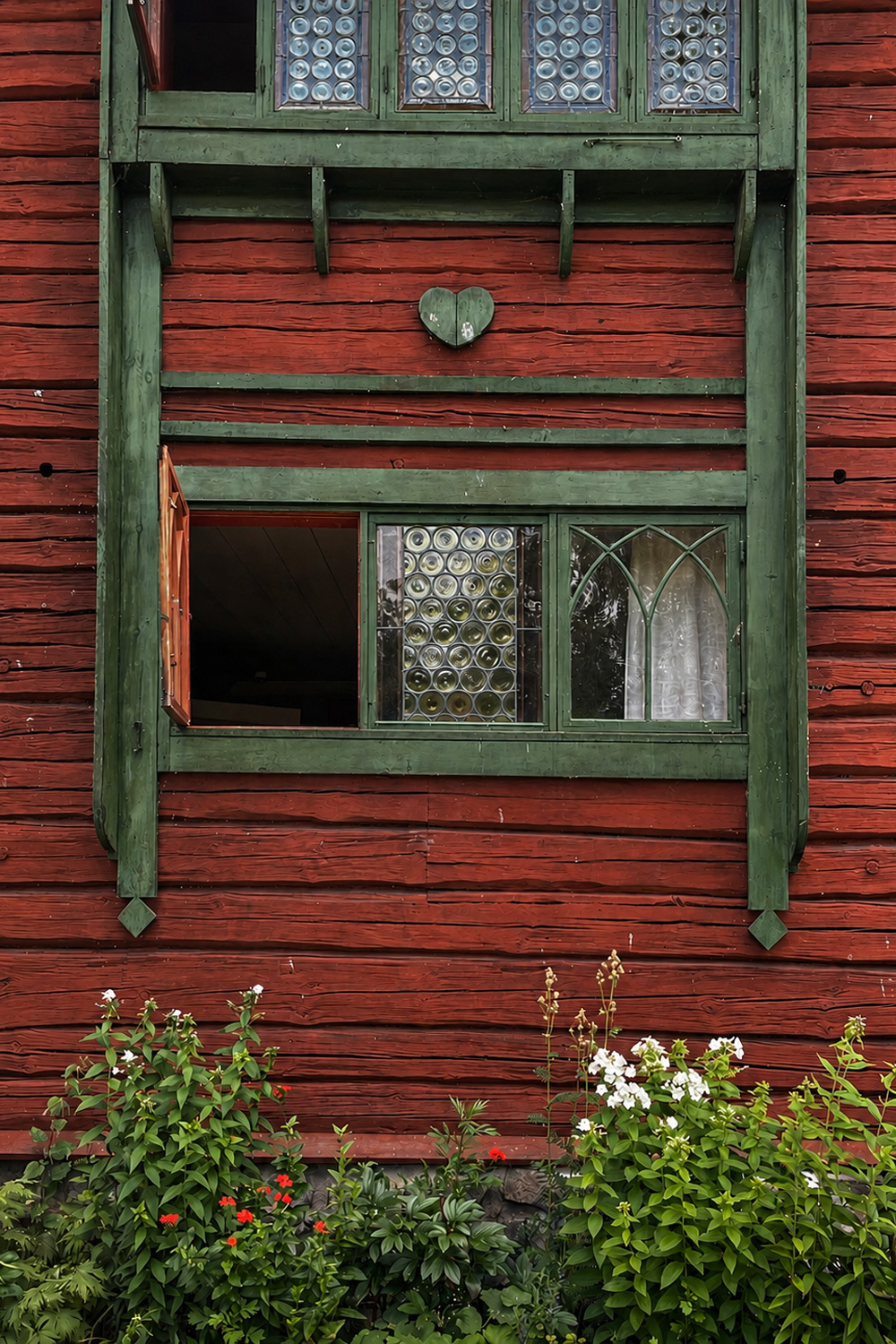
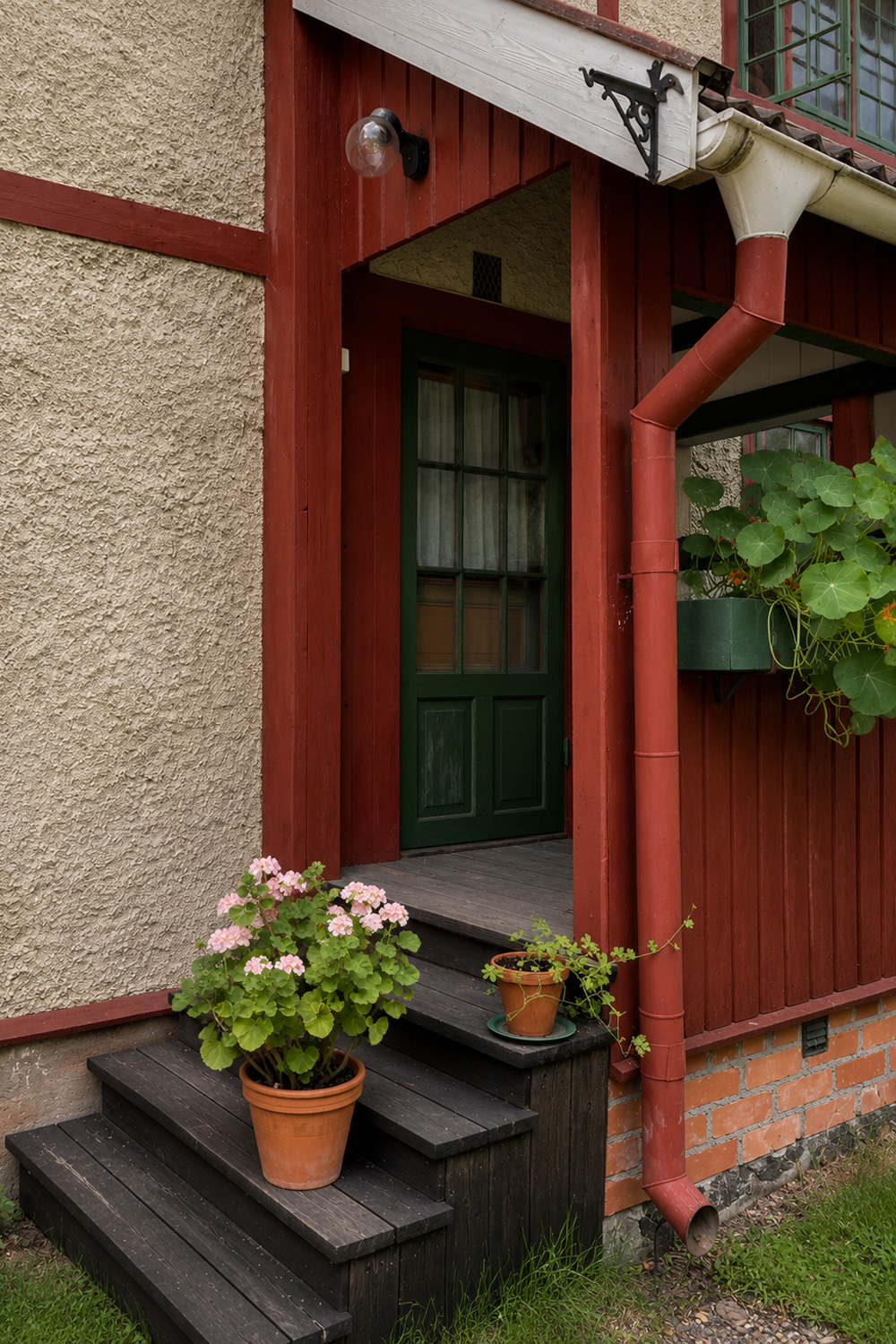
At Carl Larsson-gården, the main exhibit is Lilla Hyttnäs itself: the house in Sundborn where Carl and Karin Larsson raised their family and turned domestic life into a shared artistic project.
Karin’s father gave them the original two-room cottage in 1888. It gradually grew into 14 rooms and two studios, shaped by children, guests, work and the couple’s apparent inability to leave any surface or practical problem alone.
The family settled there permanently in 1901. By then, Carl’s watercolours had begun shaping these rooms, and the version of Swedish life they represented, far beyond Dalarna.
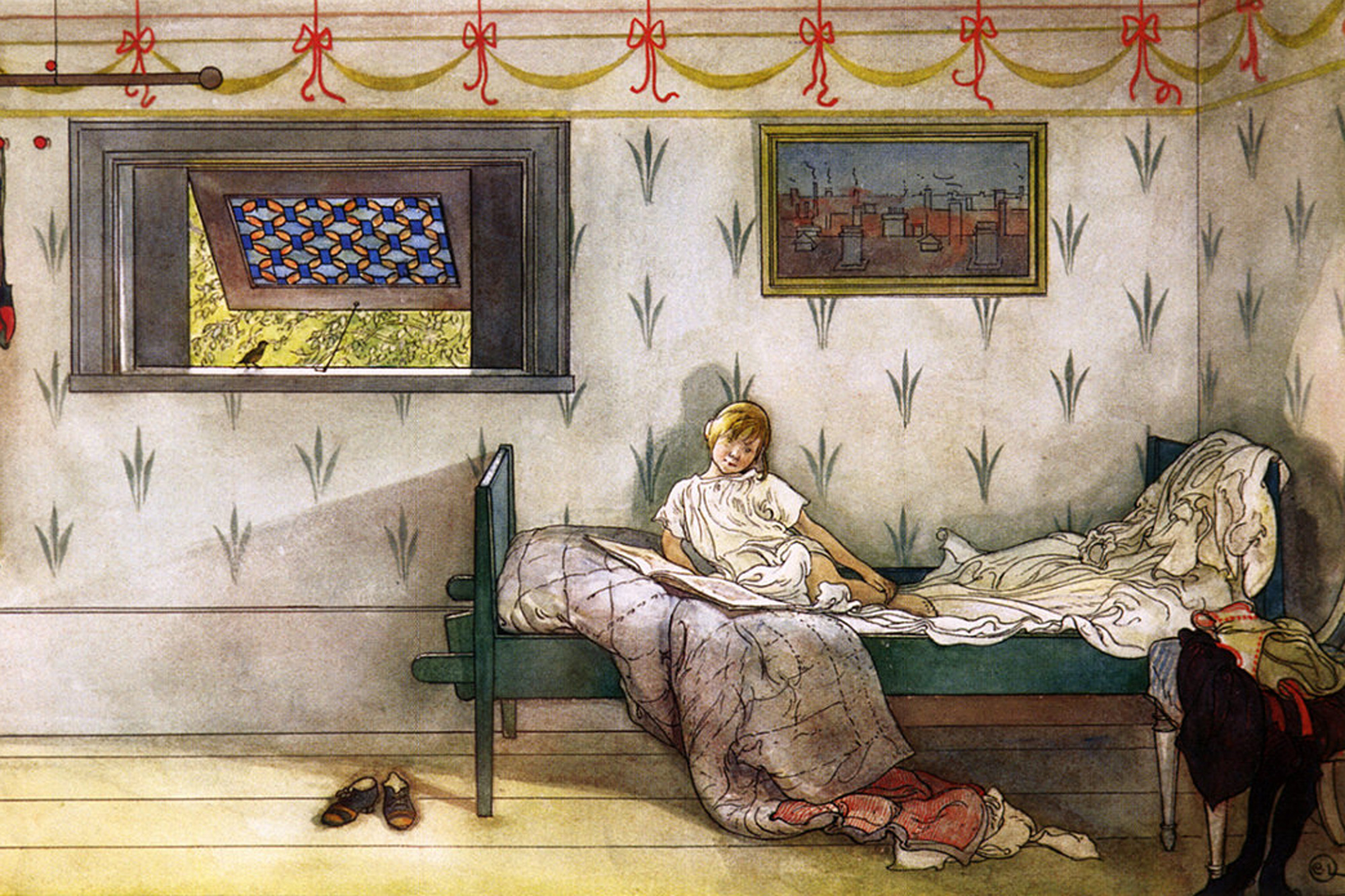
Carl was a painter and illustrator whose best-known works turned meals, games, reading, gardening and family rituals into art. Karin was also an academy-trained artist, but Lilla Hyttnäs became her principal medium. She designed furniture, wove and embroidered textiles, devised storage, made clothes for herself and the children and assembled the bold colours that still define the house. Carl painted the life taking place inside her interiors. This is why the visit cannot sensibly be framed as one famous man’s home.
A home, not a display
The interior can only be seen on a guided tour, which currently lasts around 45 to 50 minutes. Our group of ten to twelve began in the dining room before moving through every other part of the house open to visitors, including bedrooms, reading rooms, workspaces and Carl’s large studio. You cannot wander back, choose your own route or linger indefinitely, but the tour gives the rooms enough context to stop them becoming a parade of attractive old things.
The only room we did not enter was the kitchen. It remains in use by ‘the family’, a phrase that sounds rather grand until the guide explains that it refers to Carl and Karin’s hundreds of descendants, who continue to share the house throughout the year.
The six surviving children inherited Lilla Hyttnäs after Karin’s death in 1928 and transferred it to a family association in 1946. That association now has 360 members and still owns, maintains and uses the property. Family dinners are held around the dining table and Karin’s gingerbread is still baked in the kitchen at Christmas. It is a heritage attraction with an unusually convincing claim to being a living home.
Inside the paintings
Starting in the dining room makes sense. It is one of the clearest examples of how Karin’s design and Carl’s art fed each other. Red-orange cabinetry meets dark green panelling, a long white table and flower-shaped pendant lights. The colour scheme still feels unusually sure of itself, particularly beside the heavy, dark interiors favoured by much of the late-19th-century middle class.
Carl painted the room repeatedly, filling it with meals, celebrations, children, servants and guests. He also gave its walls a voice. “Guds fred” – God’s peace – appears above one doorway, while another inscription urges the children to love one another because love is everything. The sentiments are earnest, but Carl’s own account of the room is considerably drier. Writing about the bottles and jugs displayed on the sideboard, he admits that Karin disliked them before declaring that he found them “real and honest”. It is a small glimpse of the affectionate, mildly sarcastic family dynamic running through the house.
That shift between image and reality continues through the house. Carl’s work appears on walls, doors, windows, porcelain and furniture rather than being confined to frames. Portraits of Karin and the children are painted directly onto doors. A window depicts the couple during their years in the artists’ colony of Grez-sur-Loing in France, where they met in 1882.
In the reading room, Japanese woodblock prints were mounted near the ceiling so Carl could replace them when he wanted new inspiration. He never travelled to Japan, but called it his artistic ‘foster land’.
The house is full of smaller discoveries that give the tour its personality. Guests including artist Anders Zorn, writer Selma Lagerlöf and Prince Eugen left their names on the doors beside a guest bed. Karin wove seven animals into the pattern of its chair cushions, turning close inspection into a small test of eyesight.
Elsewhere, a cupboard is built into a pillar to hold brushes, books continue along the walls above Carl’s bed and daughter Suzanne’s painted floral border remains directly on her bedroom wall.
These details prevent Lilla Hyttnäs from feeling like a polished manifesto. It developed through use, experiment and the need to find space for eight children, visitors and two working artists.
Not a one-man show
The most important thing the tour does is restore Karin to the story. She stopped pursuing painting professionally as family life took over, but she did not stop working as an artist. Instead, she moved into textiles, furniture, clothes, plants and the organisation of rooms.
Her built-in beds contain storage drawers. A raised sewing area allowed looms to fit underneath and gave her a view over the garden. Her stepped flower stand brought several rows of plants towards the light. The solutions are practical, but never merely practical. Form, colour and use are treated as one problem.
Her textiles are not soft decoration added after the fact. They establish the character of individual rooms and often carry their own symbols. The woven drapery known as The Rose of Love connected Carl’s room with the bedroom shared by Karin and the children. The Four Elements covers the back of the dining-room bench. She also designed uncorseted clothes with room to move and useful pockets, an unfussy proposition that was far from conventional at the time. The striped dresses worn by guides at the house are based on one of her designs.
Carl’s success helped circulate this work. When his illustrated books reached audiences outside Sweden, readers saw Karin’s furniture, textiles, flower arrangements and colours alongside the family members he painted. The international image of a relaxed, light-filled Swedish home was therefore built from both their work, even though his name travelled further. At Lilla Hyttnäs, that imbalance is harder to maintain: Karin is present in almost every object you look at and in the way each room functions.
Built around family life
The children are equally difficult to treat as background figures once you enter their rooms. Small green beds, clothes, toys, portraits and child-sized furniture make them active occupants rather than the picturesque cast of Carl’s watercolours.
The Larssons had eight children, six of whom reached adulthood. They ate at the same table as the adults, which was not standard practice in homes of their social class at the time, and moved between the domestic rooms and their parents’ workspaces. Art was not separated from family life.
The large studio brings the different parts together. Built to accommodate Carl’s monumental work, it was one of Scandinavia’s largest studios at the time. Yet it also became a dining hall for larger celebrations, with long tables brought in for family, neighbours, craftspeople, writers, artists, princes and Nobel laureates. The studio was a workplace, social room and piece of self-presentation all at once. Like much of Lilla Hyttnäs, its purpose shifted according to whoever needed it that day.
The tour’s pros and cons
The guided format is both the visit’s strength and its main limitation. A group of around a dozen is small enough to hear the stories and see most details, but several rooms are tight and sightlines change as people move.
Anyone mainly interested in interiors may find 45 to 50 minutes brisk, particularly because there is no opportunity to return to a room once the group has moved on. The benefit is a level of information no label could provide: who painted a border, why a bed stands where it does, which guests signed a door and why the kitchen remains firmly off limits.
What is showcased, then, is not simply Carl’s taste or a series of recognisable rooms. It is the machinery behind the images: Karin constructed and continually refined the environment, Carl turned it into art, the family gave it life and their descendants have kept using it. The real house is more intriguing and inventive than the clean reproductions suggest. That gap is exactly what makes the tour worth taking.
It also leaves us wanting more time in the home. There is an app that allows visitors to revisit twelve rooms in 360 degrees, while the shop carries a substantial selection of books on the house, the art, the family and Karin’s contribution. Among them is Carl’s own Ett Hem, first published in 1899, whose 24 watercolours helped carry the image of Lilla Hyttnäs far beyond Sundborn.
We also draw on Elsa Billgren and Ulrika Ewerman’s A Home – The World of Carl and Karin Larsson, photographed by Mira Wickman, which offers a contemporary close look at rooms, textiles, cupboards and objects that visitors have little chance to study during the guided tour.
These books are valuable, as are the other publications available in the shop, but reading material and a digital return visit do not quite replace a calm place to deepen the experience while still at Carl Larsson-gården. As it stands, the guided visit opens the door brilliantly, then closes it before you have quite finished looking.